
Exclusive interview with Shashwat Brahmbhatt about Act Three (Short movie)
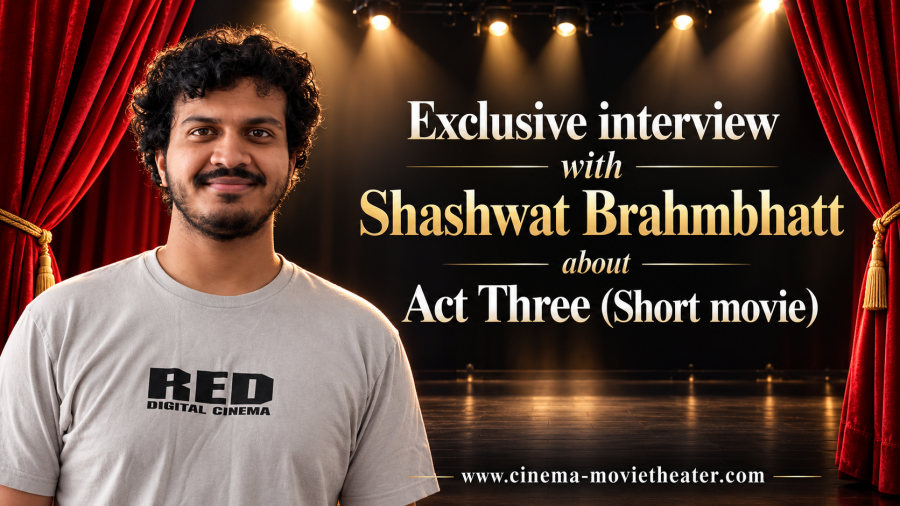
By Jean-Paul Eliard
The 7 October 2026
Hi Shashwat, I am very happy to do this interview.
Could you introduce yourself to the visitors of cinema-movietheater.com?
Hi, I’m Shashwat Brahmbhatt. I’m a production designer and filmmaker based in Los Angeles. I’m originally from India and I’ve been living and working in LA for the past 3 years.
I have a rich background of experiencing mixed sub cultures and backgrounds from India and bringing them to the US and learning about cultures and backgrounds from all around the world.
I started my filmmaking journey with my first short film, “Radha” in 2021 and also worked as an AD after that in India before I moved to LA in 2023.
What inspired you to tell Celia’s story in Act Three, and where did the idea for the film come from?
Films are often called the mirror of the society.
I think I’ve always observed women around me and also famous women all around the world would turn a certain age and people would look at them differently or start treating them differently as if
they’re unimportant.
I’ve always tried making female centric short films in my filmmaking journey and this was another issue in our society that I wanted to address or show through my film.
Celia is an actress who finds herself struggling to get major film roles as she gets older. Why was it important for you to explore this particular aspect of the film
industry?
I think we can all agree with enough proof around the world that women in the film industry or the entertainment industry for that matter have been ignored as soon as they get past a certain
age.
I think a big reason for that happening is patriarchy and the male gaze.
I think that is something that I’ve always had a problem with and I’d would always like to go against that and try to end that practice at least in and around my filmmaking journey.
An actor deserves the respect and appreciation for their craft regardless of their age, looks and other superficial factors.
The title Act Three suggests that Celia is entering a new chapter in her life. What does this title mean to you personally and in relation to her journey?
This means that Celia has not only learnt how to fight back and confront people on how they treat her and actresses like her but also getting comfortable in her own skin and not caring about what the
world has to say.
She has learned how to be an actor for herself and for her love of the craft and not for the world and it’s judgement for her.
Celia returns to theatre to rediscover herself as an artist. What do you think theatre offers her that she was unable to find in the film industry?
Theatre offers her the freedom to pursue her talent with lesser judgement and the space to move around freely and explore more physically, mentally and emotionally.
It gives her the platform to act without her having to worry about how she would be perceived by the world in every single movie theatre where her films would play.
She wouldn’t have to worry about casting directors, directors, producers, financiers, etc laughing at her for wanting to act and star as the lead characters in movies.
The relationship between Celia and the director gradually changes from difficult and confrontational to one of mentorship. What did you want to explore through their
relationship?
With Jamal’s character, I mainly wanted to explore the duality of a human before and after they’re confronted, told off and also dealt with a little bit of kindness. Celia does confront him on his
behaviour and disrespectful remarks but she also kindly lets him know that all she wants between them is a mutual respect for one another.
She also wants him to pay more attention and do this right instead of being dismissive of her every single time she makes a mistake.
That’s all she cares about. If Jamal treats her with the same amount of respect, she would feel valued or needed and feel like doing her best with the play.
You are both a filmmaker and a production designer. How did your experience in production design influence the visual world and storytelling of Act Three?
A lot of people don’t actually know this but I’ve done some theatre acting and improv in my early 20s when I was in India.
I think a lot of that has inspired the visual look of the film in a way that not only the set design or the set dressing but also the way the characters would shift from being normal for the camera
when they’re off stage to how they would be loud with their voice, expressions and body.
I always wanted to sort of combine two art forms in one of my films and this film gave me the perfect opportunity to do that.
You began your filmmaking journey with Radha in 2021 and later moved from Civil Engineering into filmmaking. How has this journey shaped you as a director and storyteller?
I think my background in civil engineering has helped me a lot with my production design work. I’ve had a lot of natural instincts towards aesthetics, colour theory, set design, set building, etc.
because of my undergrad background.
The transition wasn’t smooth initially and I did face some resistance at home from my parents because it’s not the most conventional career path in and around my family but eventually they were
really supportive and they’re still very supportive about my career switch.
I think this has really shaped as a director and storyteller because over a very little span of time, I’ve experienced working with and interacted so many different kinds of people and people with so
many different careers and backgrounds that I have a lot of different stories to tell and a lot of various perspective to tell them from.
After receiving recognition from several international film festivals, what would you like audiences to take away from Act Three about artistic reinvention, self-doubt and the possibility of
starting a new chapter?
I think the major take away I want the audience to have from “Act Three” would be that you’re never too old to try something, to discover or even rediscover yourself.
You don’t need to listen to negative comments about yourself from anyone in this world, you need to tune it all out and focus on what you want to do and what you care about.
What is your next challenge / project?
I am looking forward to working on a couple of indie feature films in the next 2-3 years as the Production Designer and Art Director.
We’re already in the pre-production stage, so I’m excited to go into the production phase soon.
Other than that, I have a couple of indie short films and student films that I will be working on next two years as the Production Designer.
Thank you very much for your interview Shashwat, I wish you the best.
More information about Shashwat on Instagram, on IMDb and on We Speak
My preview :
An excellent story for this short movie
And Actors and Actresses are very well. With a special mention for Amy, who is excellent in his role.
My mark :
10 / 10
#cinemamovietheater



My English blog

 Version imprimable