
Exclusive Interview with Keyur Gaikwad, Director of Photography and Colorist of Mon Amour
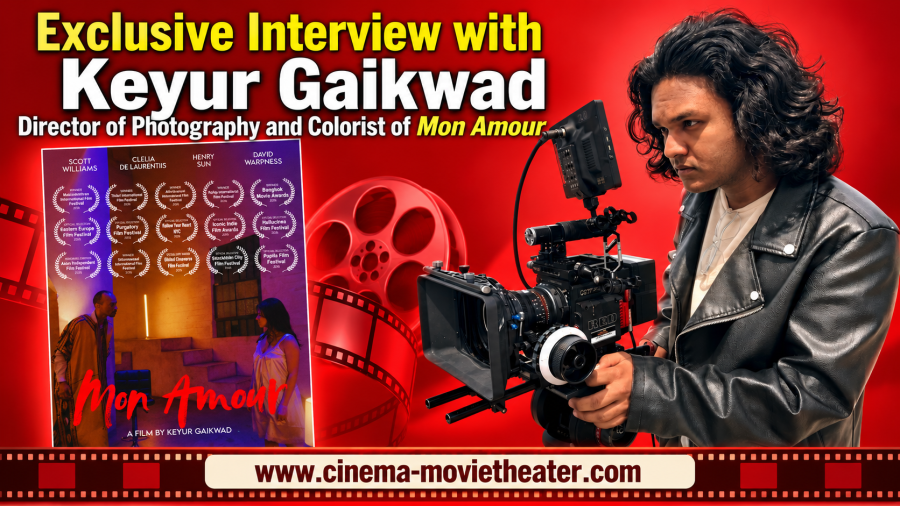
By Jean-Paul Eliard
The 23 October 2026
Hi Keyur, I am very happy to do this interview.
Hello, I’m happy to be here, thank you!
Could you introduce yourself to the readers of cinema-movietheater.com?
Of course. I’m Keyur Gaikwad, a filmmaker and multidisciplinary artist based in Los Angeles, born and raised in India.
My creative work spans narrative films, music videos, photography, painting, animation, design, music, and writing. I’m particularly drawn to visually driven, character-focused stories that feel
personal and intimate while leaving room
for ambiguity and individual interpretation.
Beyond filmmaking, painting has been a constant part of my creative life.
I primarily explore surrealism, impressionism, and expressionism, which continues to shape my approach to composition, light, color, texture, and emotional tone. Music, writing, and design further
shape my understanding of human beings, their emotional complexities, and their relationships.
I practice all these different art forms and love bringing these disciplines together in my film work! In filmmaking, I primarily work as a director,
director of photography and colorist.
Your short film Mon Amour is a surrealist black comedy exploring artistic ambition, narcissism, and relationships. What inspired you to take part in this project, and what attracted you most
to its story?
What fascinated me the most was the idea. It was a simple plot with complex characters. Because if you boil it down to its very basic nature, it is a story
about a couple having an argument.
But then, it has these complex characters battling each other and themselves, as you mentioned the artistic ego, narcissism, this very toxic and abusive relationship- those ideas were worth
exploring.
Then there’s the strange location, a human-sized bunny and an eerie voice.
So it was a really simple story residing in this sort of a heightened or dream-like reality, and that excited me the most, even as I was developing it.
The film combines theatrical imagery, dark humor, and psychological tension. As Director of Photography, how did you approach the visual storytelling to bring Curtis’s distorted perception of
reality to life?
That was interesting to work on for sure, and it started in pre-production.
The decision to shoot the entire film as a oner came from this idea of it being
a live performance, and the camera being an audience member walking on
the stage and watching it unfold, to give this sort of an immersive experience.
To heighten the tension and dark humor beats, I wanted to execute some deliberate framing choices which would not only looks beautiful but also enhance any given emotion in the scene.
The lighting choices further amplified the surrealist nature of the film.
I wanted to have lighting that resists naturalism, to create a sense of artificial reality. We had three distinct colors- red, blue and yellow; with no explanation for where these lights were coming
from.
We also played with the idea of having the Bunny walk in our frames or be in the background in our frames to make his existence (to Curtis) seem real and consistent, especially when Curtis needed
comfort.
The voice was a harsh manifestation of his schizophrenia, while the Bunny provided him comfort, and it was crucial to make the Bunny’s presence known in those moments.
The key cinematography choice was for the camera to be subjective, providing Curtis’ thematic point of view.
You also worked as the film’s Colorist. How important was color grading in creating the film’s surreal atmosphere and conveying the characters’ emotions?
It was extremely important. Especially since we had all these beautiful colors with our lighting, it was crucial to do them justice in post-production.
Also, since we had different lighting setups within the film, but the entire film was a oner, it was challenging to maintain color, exposure and contrast consistency throughout the piece.
I worked with keyframes and seamless transitions for the color grade, to ensure each set up looked the way it was intended to, and that all the setups together support the film’s unified visual
aesthetic.
Your artistic influences include Frida Kahlo, Salvador Dalí, and filmmaker David Lynch. How have their works influenced your artistic vision, and can we see their influence in Mon
Amour?
The artists that I love and admire continue to influence my artistic vision across genres. It’s not just their art, but their way of thinking, their perspectives that enlighten me.
We definitely see their influences in Mon Amour. I started out as a surrealist myself, so Kahlo, Dali and David Lynch are very close to my heart, but
Mon amour derives a lot of references from various artists, especially in our blocking and framing.
When I was storyboarding the film during pre-production, I derived references from artists like Matejko, Hope Gangloff and a lot from Edward Munch.
These paintings did not only serve as references but also made me investigate the thought process behind them, which then inspired a lot of the frames for the film. You can see a lot of parallels
between stills from the film and paintings that inspired those visuals.
I also drew inspiration from films like Birdman, Malcolm & Marie, Venus in fur and Dogville. I built on the idea of using the room as a psychological landscape to reflect Curtis’ mental state; to
use theatricality and artificial construction of reality; to explore isolation within intimacy; and the subconscious, which was all heavily inspired by David Lynch’s films.
You were born and raised in Pune, India, before moving to Los Angeles to study filmmaking at the New York Film Academy. How has your personal journey and cultural background shaped your
approach to cinema?
Honestly, I’m not really sure if I have an exact answer to that question.
I’m incredibly grateful to be from Pune, India, because I grew up in a city so rich in history, tradition, and art.
I think that gave me a certain sense of observation and an appreciation for
the way people communicate and express themselves. My early exposure to Marathi literature, music, theatre, and cinema has contributed so much to who
I am as a person, in ways I honestly don’t even fully understand.
At the same time, I was watching a lot of Hollywood and foreign films with my father from a young age, and I fell in love with cinema. I was also introduced to music, literature, and art from
different parts of the world early on, so I think I’ve always been drawn to exploring different perspectives and ways of looking at life.
When I moved to Los Angeles, I realized that it was very similar to my hometown in many ways, and that was a comforting feeling. More than my cultural background, I think it’s the sheer variety of
people I’ve met, loved, learned from, and observed throughout my life that has shaped me as a person, and I think that reflects in the films I make.
* Mon Amour has received seven festival awards, two honorable mentions, and six official selections. What does this international recognition mean to you, and how has it
influenced your career as a filmmaker?
- It makes me really happy to see Mon Amour receive the recognition I feel it deserves, and to know that, through the festival circuit, more and more people are getting the opportunity to come
together and watch it.
I think cinema is such a beautiful collective experience. There’s something inexplicably special about laughing or gasping alongside a hundred strangers in a packed theatre.
Knowing that Mon Amour can reach people in that way is genuinely heartwarming. I’m incredibly grateful to all the film festivals that have selected the film, for the awards it has received so far,
and for helping me share it with audiences around the world.
You are also involved in painting, photography, and writing. What are your future artistic projects, and what kind of stories would you like to tell through your films in the coming
years?
I am excited for quite a few really amazing films lined up over the next few years as a Director of Photography and Colorist.
I’m also currently writing a romantic drama that feels like my most personal project to date and I cannot wait to share it with the world soon. I want to continue telling stories that have
heart.
I’m drawn to stories that let me really explore the characters, their lives, emotions, and relationships, and that leave the audience with something to think about, and those are the kind of stories
I'd love to continue creating, without limiting myself to any particular genre.
What is your next challenge or project?
My next project is a beautifully written film that is very similar to Mon Amour in many ways, especially for its bold story and creative choices. I am really excited to work on it as the
Director of Photography and to craft a fascinating visual language for it.
Do you have anything else you'd like to add?
Not really. Thank you for having me. It has been a pleasure!
Thank you very much for this interview, Keyur. I wish you all the best!
More information about Keyur on Likedin and on IMDb
* International
Film Festival Recognition
Mon Amour has received seven festival awards, two honorable mentions, and six official selections, earning recognition across international
independent and experimental film communities.
Awards and honors include:
Global Cineverse Film Festival — Winner, Best International Short Film
Bangkok Movie Awards — Winner, Short Film
Rohip International Film Festival — Winner, Best US Short Film
Makizhmithran International Film Festival — Winner, Best Experimental Short Film
Athvikvaruni International Film Festival — Winner, Best Experimental Short Film
Thilsri International Film Festival — Winner, Best Experimental Short Film
Sittannavasal International Film Festival — Winner, Best Experimental Short Film
Stockholm City Film Festival — Honorable Mention, Best Experimental Film
Asian Independent Film Festival — Honorable Mention, Best Short Film
The film has also earned official selections at Purgatory Film Festival, Hallucinea Film Festival, Pupila Film Festival, Iconic Indie Film
Awards, Eastern Europe Film Festival, and Follow Your Heart NY.
This international recognition highlights the film’s distinctive creative approach and growing presence within the independent cinema
landscape.
My preview :
A surrealist black comedy unfolding over 14 minutes, where a
vain playwright and his young French wife spiral into a grotesque battle over their new play.
An excellent story for this short movie
And Scott Williams
and Clelia DeLaurentis are excellent, in this surrealist black comedy.
My mark :
09 / 10
#cinemamovietheater



My English blog

 Version imprimable
